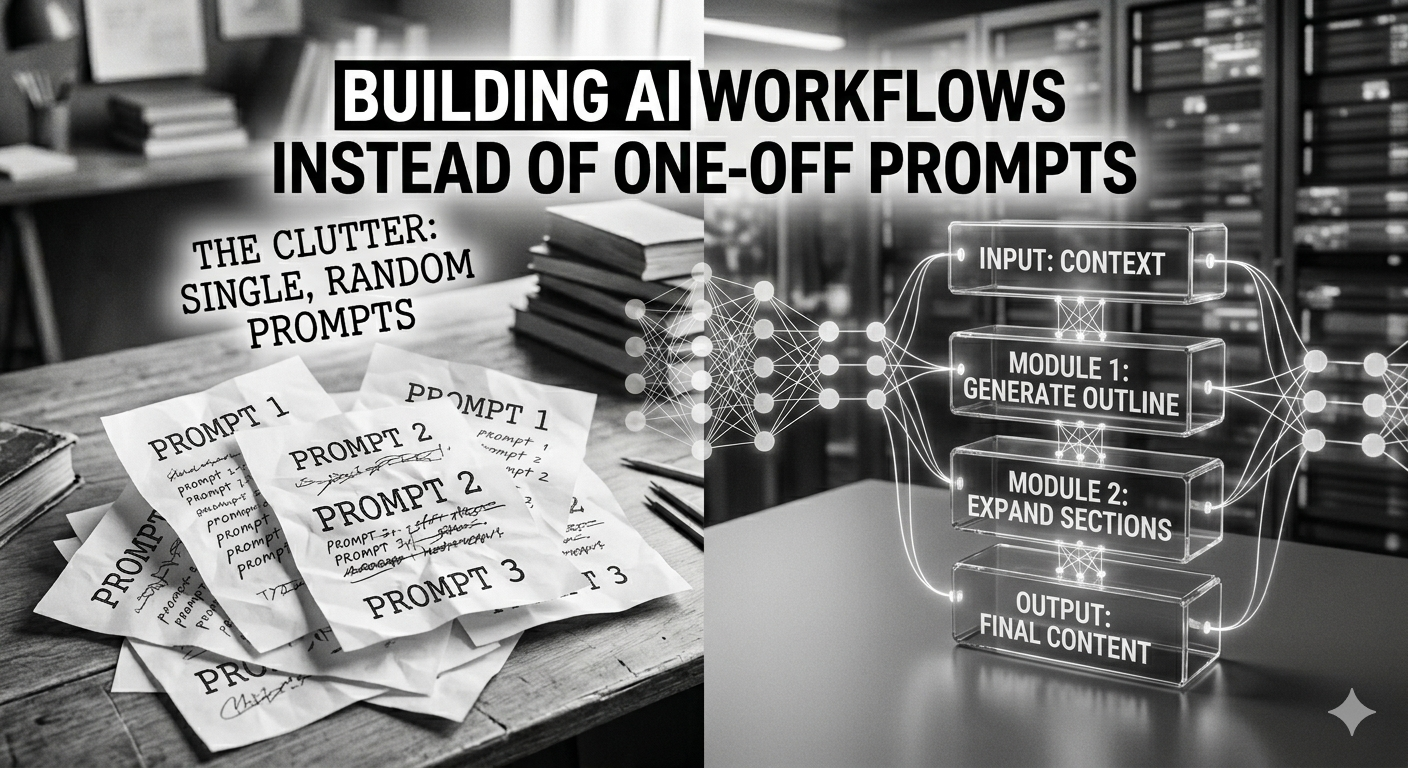
One of the biggest mistakes people make with AI is treating it like a magic vending machine.
They type a request, receive an output, copy the result, and repeat the process tomorrow from scratch.
That approach works occasionally for simple tasks.
But it breaks down quickly when the work becomes:
- repetitive
- strategic
- high-volume
- client-facing
- research-heavy
- brand-sensitive
- multi-step
This is why I rarely think in terms of individual prompts anymore.
I think in workflows.
The Difference Between a Prompt and a Workflow
A one-off prompt is a single instruction designed to produce a single output.
Examples:
- “Write a LinkedIn post.”
- “Generate an SEO article.”
- “Create product descriptions.”
- “Summarize this research paper.”
There is nothing inherently wrong with this.
The problem is that real work rarely happens in one step.
A strong blog post requires:
- topic research
- audience analysis
- headline generation
- outline creation
- draft writing
- editing
- SEO refinement
- distribution planning
That is a workflow.
The moment you recognize this, AI becomes far more useful.
Most AI Frustration Comes From Missing Structure
Many people believe AI outputs are inconsistent because the models are flawed.
Sometimes that is true.
But more often, the inconsistency comes from unclear operational structure.
People ask AI to perform tasks without defining:
- objectives
- context
- quality standards
- voice
- constraints
- formatting rules
- success criteria
Imagine hiring a human employee and giving instructions like:
“Just make something good.”
That employee would struggle too.
AI systems reward structured thinking.
My Workflow Philosophy
When I design AI systems, I try to break work into logical stages instead of giant all-in-one prompts.
This matters because different stages require different forms of thinking.
Research is different from persuasion.
Editing is different from brainstorming.
SEO optimization is different from storytelling.
Separating these stages improves quality dramatically.
A weak AI workflow tries to force one prompt to do everything.
A strong AI workflow assigns different responsibilities to different prompts operating together like components inside a system.
How I Typically Structure AI Workflows
Most of my systems follow a repeatable architecture.
Not because rigidity is good — but because consistency reduces friction.
1. Define the Objective Clearly
Before prompting anything, I define:
- What is the actual goal?
- Who is the audience?
- What outcome matters most?
- What constraints exist?
This sounds obvious.
But most weak prompts fail before the first word because the operator never clarified the objective properly.
2. Separate Research From Generation
This is one of the biggest improvements most people can make immediately.
Do not ask AI to research and write simultaneously unless the task is extremely simple.
Instead:
- first gather ideas
- then organize insights
- then generate structure
- then create outputs
Breaking these apart improves reasoning quality substantially.
3. Use Role-Based Prompting Carefully
I often assign AI a specific role:
- editor
- research analyst
- copywriter
- SEO strategist
- critic
- customer persona
Not because the AI literally becomes that profession.
But because role framing changes the style of reasoning and output priorities.
4. Create Reusable Prompt Components
Instead of rewriting prompts constantly, I build modular sections:
- tone instructions
- formatting rules
- brand voice definitions
- audience descriptions
- quality constraints
- SEO requirements
Then I combine these pieces depending on the task.
This is far more scalable than improvising every prompt from scratch.
Why Modular Systems Scale Better
One-off prompts create dependency on memory and improvisation.
Workflows create operational consistency.
That matters especially for:
- content teams
- marketing agencies
- newsletter businesses
- SEO publishers
- sales systems
- client work
- automation pipelines
A modular workflow also makes optimization easier.
If quality drops, you can isolate the weak component instead of rebuilding the entire system.
The Real Goal Is Not Content Generation
This is important.
Many people think AI workflows exist merely to generate content faster.
That is only partially true.
The larger goal is reducing cognitive friction.
A good workflow:
- removes repetitive thinking
- reduces decision fatigue
- improves consistency
- preserves quality standards
- accelerates iteration
- creates operational clarity
The result is not merely speed.
The result is leverage.
Actionable Recommendations
If you want to move beyond random prompting, here are several practical changes you can implement immediately.
Stop Writing Giant Mega-Prompts
Most enormous prompts are compensating for poor workflow design.
Instead of one massive instruction, break tasks into stages.
Create Reusable Prompt Blocks
Build reusable modules for:
- voice
- audience
- formatting
- quality standards
- SEO rules
- editing instructions
This reduces inconsistency dramatically.
Document Your Best Workflows
Most people accidentally discover effective prompts and then lose them.
Document successful workflows immediately.
Create your own internal operating system.
Treat AI Like a Collaborative System
Do not expect perfection from a single output.
Use iteration intentionally:
- research
- outline
- draft
- refine
- critique
- optimize
This produces dramatically stronger results than single-pass generation.
Final Thought
The people getting the most value from AI are usually not the people writing the cleverest prompts.
They are the people building the clearest systems.
That is an important distinction.
A one-off prompt might save you a few minutes.
A well-designed workflow can change how an entire business operates.
And over time, that difference compounds.
Build Better AI Systems
Subscribe for prompt engineering insights, workflow design strategies, AI systems, and practical frameworks built for people doing real work.
Leave a Reply