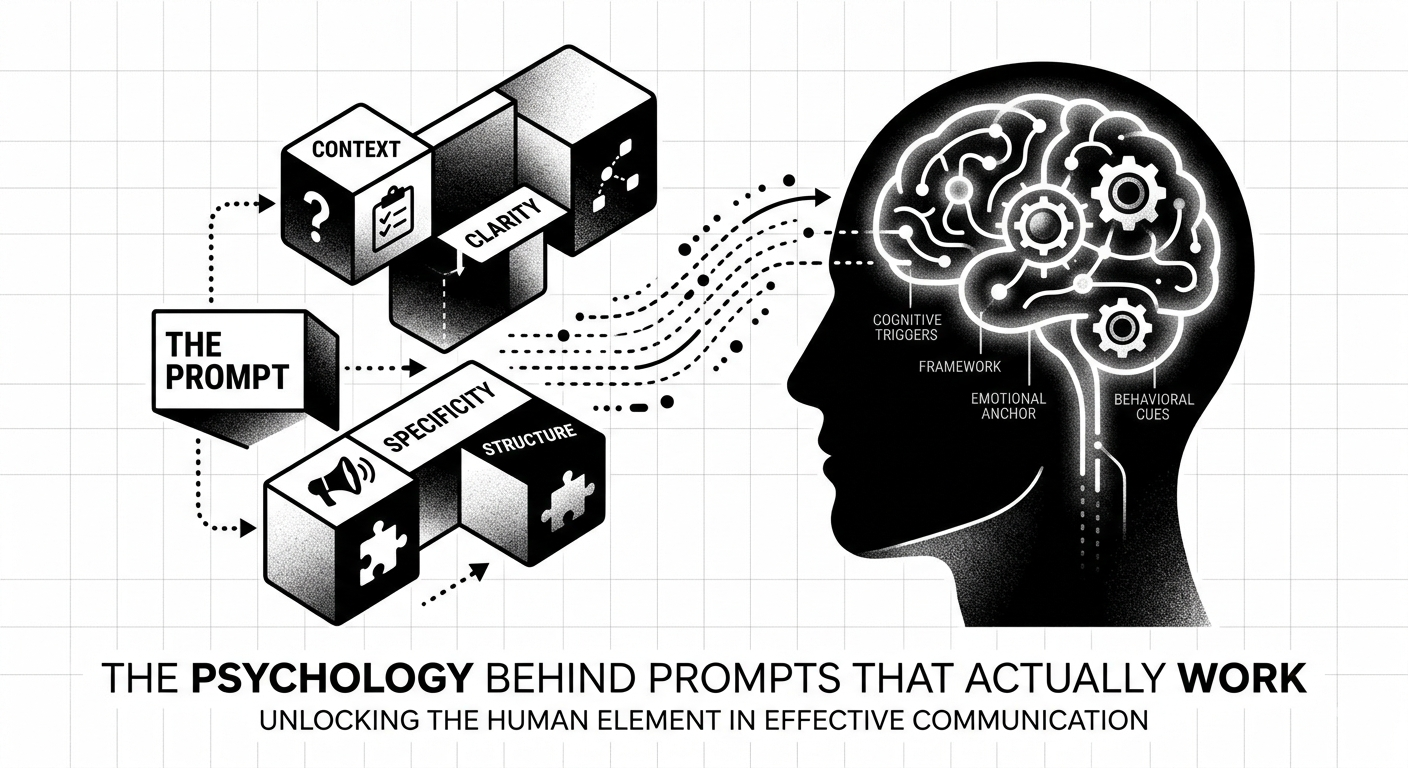
Most people think prompting is about finding the right magic words.
It isn’t.
The difference between a weak prompt and a strong one usually has less to do with technical expertise and more to do with psychology. Specifically: understanding how humans communicate clearly enough for a machine to follow the intent.
That may sound obvious. It also happens to be the part most people skip.
Small business owners, salespeople, and entrepreneurs are especially vulnerable to this because they are busy. They open ChatGPT, type a vague request like “write me a sales email,” receive something generic, and conclude that AI is overhyped.
In reality, the problem is usually the instruction itself.
Artificial intelligence systems are remarkably capable pattern-recognition tools, but they still depend heavily on context. When your prompt lacks specificity, structure, or direction, the model fills in the blanks using statistical averages pulled from millions of examples online.
And averages are rarely persuasive.
Why Generic Prompts Produce Generic Results
Imagine hiring a salesperson and giving them this instruction:
“Go sell something.”
You would expect questions.
Who is the customer?
What is the product?
What problem does it solve?
What tone should be used?
What objections are common?
What is the goal of the conversation?
Yet many people approach AI with less detail than they would give a summer intern.
The model responds accordingly.
This is why so many AI-generated outputs sound polished but empty. They are built from broad assumptions instead of useful constraints.
Strong prompts narrow the field. They reduce ambiguity. They guide the model toward a clearer objective.
In many ways, prompting resembles management more than programming.
Good Prompts Create Friction in Useful Places
One of the most misunderstood aspects of prompt engineering is the role of constraints.
People often assume creativity comes from total freedom. In practice, useful outputs usually emerge from limitation.
Consider these two prompts:
“Write a marketing email.”
Versus:
“Write a 150-word email for a local HVAC company targeting homeowners over 50. Use a calm, trustworthy tone. Avoid hype. Mention rising summer temperatures and the importance of preventative maintenance. End with a soft call-to-action.”
The second prompt works better because it forces specificity.
The AI no longer has to guess the audience, tone, format, or purpose. It can spend more computational energy generating relevant language instead of solving basic uncertainty.
This principle applies across nearly every business use case:
- sales outreach
- content creation
- customer support
- hiring
- lead generation
- SEO
- scripting
- research
The clearer the objective, the stronger the result.
The Best Prompts Sound Like Good Leadership
Experienced managers tend to communicate in ways that reduce confusion:
- clear expectations
- defined outcomes
- useful examples
- measurable goals
- contextual information
The same habits improve prompting.
One of the simplest ways to improve AI outputs is to stop thinking in commands and start thinking in briefings.
Instead of:
“Write a blog post.”
Try:
“You are writing for small business owners with limited technical experience. The article should feel practical, conversational, and slightly skeptical of hype. Keep paragraphs short. Use real-world examples. Avoid corporate jargon.”
That additional context dramatically changes the output because you are shaping the behavior, not merely requesting content.
AI Is Extremely Sensitive to Tone
This surprises people.
AI models respond heavily to linguistic framing. Subtle wording changes can alter:
- confidence
- complexity
- emotional tone
- sentence structure
- pacing
- depth
For example:
“Explain this like a consultant” produces different results than:
“Explain this like a patient teacher speaking to a busy business owner.”
Neither is inherently better. They simply optimize for different communication styles.
This matters because businesses do not fail from lack of information. They often fail from poor communication.
An AI system that sounds intelligent but inaccessible is not useful to most customers.
Prompting Is Becoming a Business Skill
Right now, many people still view prompt engineering as a niche technical specialty.
That will change.
Businesses are beginning to realize that the ability to guide AI effectively influences productivity across departments:
- marketing
- operations
- customer service
- research
- sales
- training
- administration
The people who benefit most from AI over the next several years will not necessarily be the most technical.
They will be the people who can think clearly, communicate precisely, and structure information effectively.
In other words: people who already understand how persuasion, context, and language work.
A Practical Way to Improve Immediately
If you want better outputs today, start using this simple framework:
1. Define the role
Who should the AI behave like?
Example:
“You are an experienced sales consultant.”
2. Define the task
What exactly should it do?
Example:
“Write a follow-up email after a missed sales call.”
3. Define the audience
Who is receiving the communication?
Example:
“The reader is a busy roofing contractor.”
4. Define the constraints
What should the AI avoid or prioritize?
Example:
“Keep under 120 words. Avoid sounding pushy.”
5. Define the tone
How should it feel?
Example:
“Professional, calm, conversational.”
That alone places you ahead of most users.
Final Thought
The future of AI will not belong exclusively to engineers.
It will belong to people who know how to think clearly enough to direct intelligent systems effectively.
Prompting is not magic. It is structured communication.
And structured communication has always been valuable.
Leave a Reply