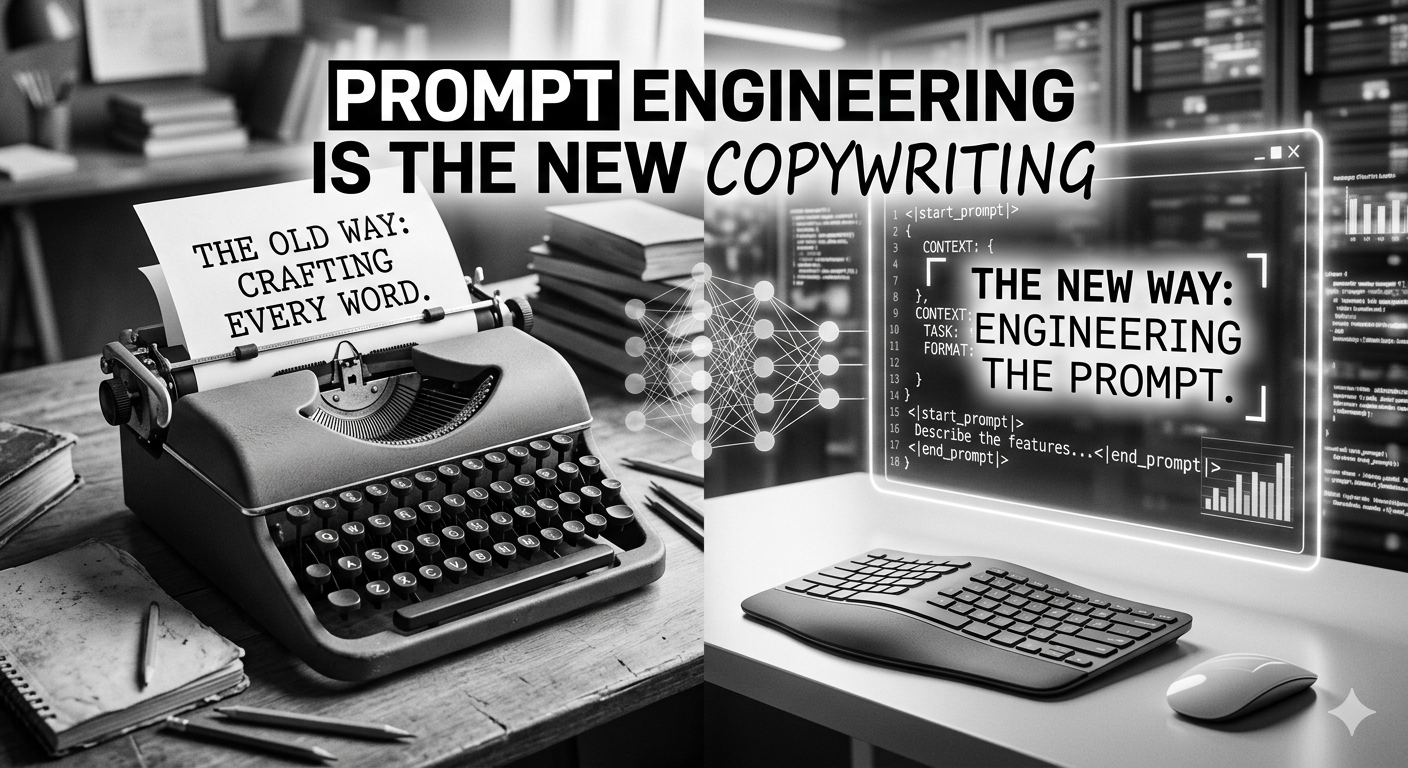
There was a time when the most valuable person in a marketing department was the copywriting specialist.
The person who could choose the right words controlled attention. And attention controlled money.
A skilled writer could sell newspapers, insurance, software, luxury products, political campaigns, or entire belief systems using nothing but carefully structured language.
That reality has not disappeared.
But something fundamental has changed.
Today, the people gaining leverage are not merely those who write persuasive words for humans.
They are the people who write persuasive instructions for machines.
That is prompt engineering.
Prompt Engineering Is Not Merely “Talking to AI”
Most people misunderstand prompt engineering completely.
They think it means typing commands into ChatGPT.
It does not.
Prompt engineering is the ability to shape machine behavior through structured language.
And once you recognize that, the similarities to copywriting become impossible to ignore.
Both disciplines revolve around:
- clarity
- psychology
- sequencing
- context
- constraints
- tone
- positioning
- desired outcomes
A weak copywriter writes:
“Buy this product because it is great.”
A strong copywriter understands audience psychology deeply:
- fear
- desire
- skepticism
- motivation
- objections
- timing
- friction
The same principle now applies to AI systems.
A weak prompt says:
“Write me a blog post.”
A strong prompt establishes:
- role
- objective
- audience
- constraints
- tone
- format
- examples
- reasoning structure
In both cases, better inputs produce better outputs.
The Best Prompt Engineers Think Like Editors
One of the strangest developments in AI is that many technically skilled people struggle badly with prompting.
Meanwhile, experienced writers, marketers, strategists, and journalists often adapt quickly.
Why?
Because prompt engineering is less about coding syntax and more about cognitive architecture.
The strongest prompt engineers understand:
- how information flows
- how ambiguity breaks systems
- how wording changes interpretation
- how context alters outputs
- how structure shapes behavior
They think like editors.
Or perhaps more accurately:
they think like experienced creative directors.
Most AI Outputs Fail Before the First Word
This is why so much AI-generated content feels lifeless.
The problem is often not the model itself.
The problem is the thinking behind the prompt.
Most prompts are vague requests disguised as instructions.
People ask AI to:
- “make this better”
- “write something viral”
- “improve this email”
- “generate a strategy”
But they provide no real strategic framing.
No audience understanding.
No positioning.
No constraints.
No communication goals.
Imagine hiring an elite writer and saying:
“Just write something good.”
You would never do that.
Yet people do exactly this with AI every day.
Prompt Libraries Are the New Swipe Files
Old-school marketers carried swipe files.
Collections of headlines, advertisements, offers, guarantees, and sales letters used to study patterns and persuasive structure.
Today, high-quality prompts are becoming the modern equivalent.
A strong Prompt Library is not merely a folder of commands.
It is a structured archive of tested thinking:
- workflow systems
- reasoning structures
- automation frameworks
- communication architectures
- behavioral constraints
- strategic templates
A good prompt saves time.
A great prompt changes how work itself gets done.
Constraint Design Is the Hidden Skill
One of the least discussed aspects of prompt engineering is the importance of constraints.
Ironically, constraints improve creativity.
This has always been true in writing.
A billboard has limited space.
A headline must communicate instantly.
A landing page must reduce friction quickly.
The same applies to prompting.
The strongest prompts often contain instructions like:
- avoid clichés
- do not exaggerate
- write naturally
- avoid sounding AI-generated
- maintain a warm professional tone
- focus on benefits before features
These are not arbitrary limitations.
They are quality controls.
The Future Belongs to Human Directors
Many people still believe AI adoption is primarily technical.
It is not.
It is editorial.
The winners will not necessarily be the people with the most advanced models.
They will be the people best able to:
- frame problems clearly
- structure information intelligently
- direct outputs strategically
- evaluate quality critically
- communicate with precision
This is why the modern Prompt Library matters so much.
It transforms AI from a novelty into a repeatable operational system.
And historically, people who control language tend to control outcomes.
Final Thought
Good writing once gave individuals leverage over distribution.
Prompt engineering gives individuals leverage over production itself.
That is a far larger shift than most people currently understand.
The people mastering prompt engineering are not merely learning how to use AI tools.
They are learning how to direct computational labor through language.
And that changes everything.
The modern Prompt Library may eventually become just as important to digital businesses as websites, CRMs, or email systems once were.
Build Better AI Systems
Subscribe for prompt engineering insights, AI strategy, content systems, and practical frameworks designed for people doing real work.
Leave a Reply