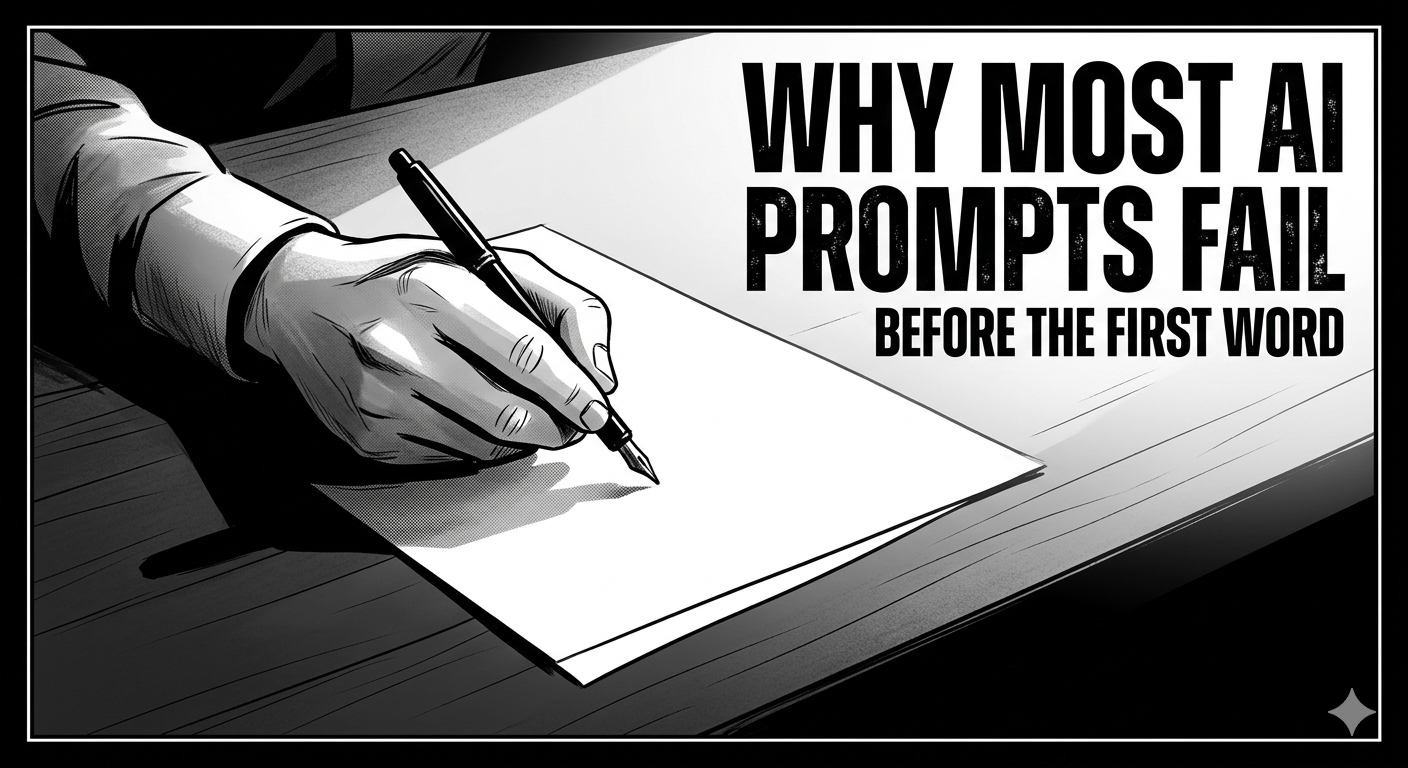
Most people think prompt engineering starts when you type.
It doesn’t.
It starts earlier—quietly, and usually invisibly—at the moment you decide what you’re actually asking for.
And in most cases, that’s where things go wrong.
The real problem isn’t the AI
When people get disappointing results from AI, the instinct is to blame the tool.
“It didn’t understand me.”
“It gave me something generic.”
“It’s not creative enough.”
But in practice, the model is rarely the issue.
Modern AI systems are highly capable of reasoning, structuring, and generating nuanced output.
The limitation is usually upstream: the prompt never gave it anything specific enough to work with.
Most prompts begin too early
Here’s what a typical prompt looks like:
“Write a landing page for my product.”
That’s not really a prompt. It’s an instruction without architecture.
There’s no audience definition. No positioning. No conversion goal. No tone constraint. No awareness of objections or context.
So the model does what it is designed to do in uncertainty: it averages everything it has seen.
The result is not wrong. It’s just uninteresting—and usually ineffective.
What’s missing is structure, not effort
People often assume better outputs require more detailed wording.
So they add adjectives. They add longer instructions. They try to “explain better.”
But verbosity is not structure.
You can write a very long prompt and still fail to define the key variables that actually shape output quality.
Those variables are usually things like:
- Who the content is for
- What decision it is meant to influence
- What resistance exists in the reader
- What success looks like
- What tone is appropriate for that situation
If those are missing, the model is guessing—no matter how long the prompt is.
Why prompts fail before the first word
The phrase sounds dramatic, but it’s accurate.
Because the failure doesn’t begin at generation.
It begins at framing.
Before you ever write “act as a…” or “generate a…”, you’ve already decided whether the task is clear or ambiguous.
If the goal is unclear, everything after it becomes noise reduction.
If the goal is structured, everything after it becomes execution.
Good prompts behave like systems
Strong prompts don’t just request output.
They set conditions for output quality.
They guide the model through a mental sequence:
- Understand the situation
- Define the audience or context
- Identify constraints and goals
- Structure the reasoning process
- Then generate the final result
This is the difference between asking for something and designing for something.
One produces randomness. The other produces consistency.
The quiet advantage of constraints
Constraints are often misunderstood as limitations.
In reality, they are what make output usable.
Without constraints, AI explores too broadly. It defaults to safe, average patterns.
With constraints, it narrows focus and becomes significantly more precise.
This is why structured prompts outperform “creative freedom” prompts in most business use cases.
A simple mental shift
There’s a useful way to think about it:
A weak prompt asks the AI to write something.
A strong prompt tells the AI what situation it is operating in, what outcome matters, and what boundaries it must respect.
That shift alone changes output quality more than any stylistic tweak ever will.
Where most people improve too late
Many users only start refining their prompts after they see bad output.
They iterate reactively—fixing wording instead of fixing structure.
But the real leverage is upstream.
If the framing is wrong, no amount of refinement downstream fully fixes it.
If the framing is right, even simple prompts can produce strong results.
Closing thought
Prompt engineering is often described as the art of writing instructions.
It’s more accurate to think of it as the discipline of defining clarity before writing begins.
Because most AI prompts don’t fail at the model level.
They fail at the moment they fail to define what success actually means.
Leave a Reply