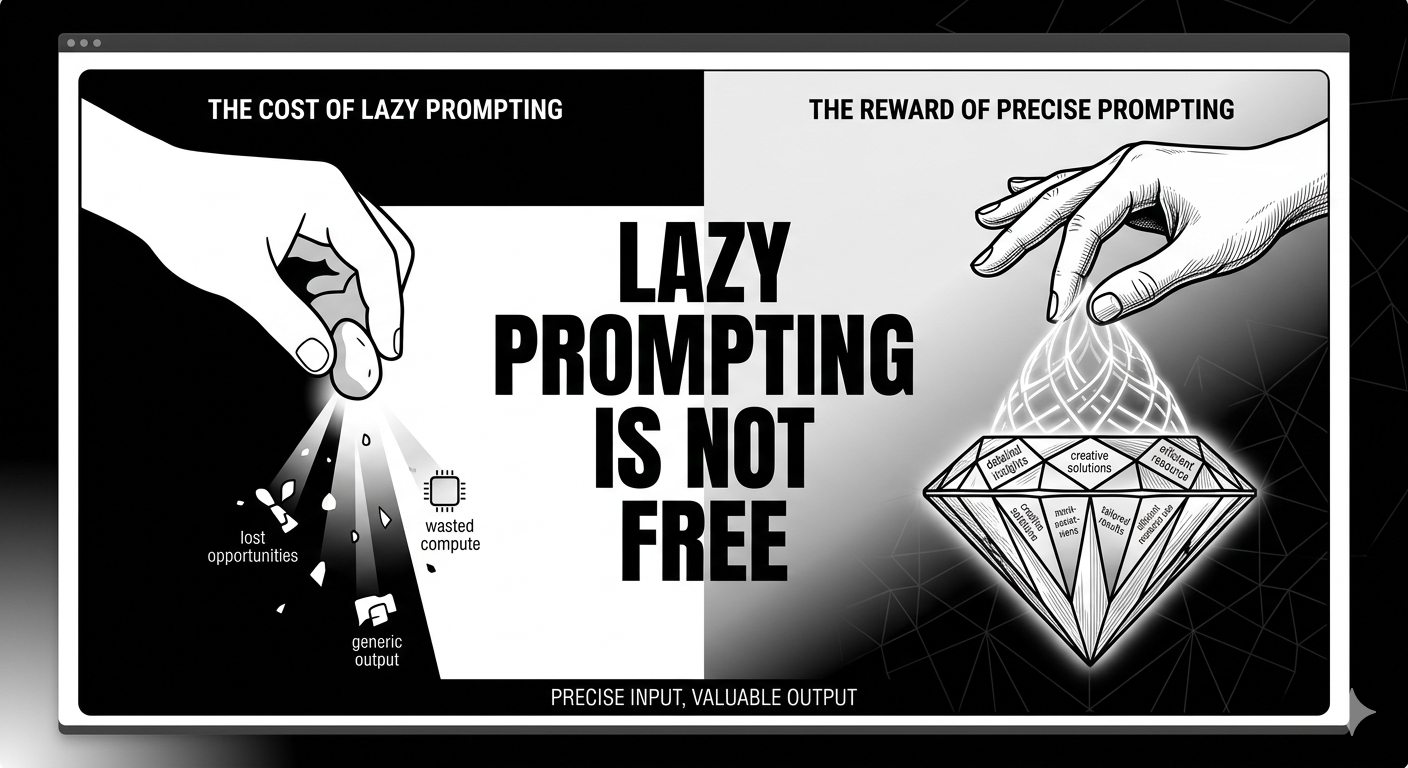
How vague AI instructions are quietly draining your time, money, and competitive edge
You bought into the promise. AI was going to save you hours every week — cranking out emails, summarizing reports, drafting proposals, answering customer questions. And it can do all of that. But if you’re like most business owners and salespeople who picked up an AI tool in the last year or two, you’ve probably had this experience more than once: you type something in, get a result that’s… fine, spend ten minutes fixing it, and wonder why you didn’t just write the thing yourself.
That frustration isn’t a flaw in the technology. It’s a prompting problem.
And it’s costing you more than you think.
What “Lazy Prompting” Actually Means
Lazy prompting isn’t an insult — it’s a pattern. It’s what happens when we treat AI the way we’d treat a search engine: fire off a quick phrase and hope for the best.
“Write me a sales email.”
“Summarize this document.”
“Give me some ideas for social media.”
These aren’t bad requests. They’re just incomplete ones. The AI fills in the blanks with assumptions — and those assumptions rarely match your business, your voice, your customer, or your goal. What comes back is generic. Technically functional, but ultimately useless without significant editing.
That editing time? That’s the hidden cost.
The Real Numbers Behind a Vague Prompt
Let’s put some rough math to this. Say you use AI prompting five times a day — a modest number for anyone running a business or managing a sales pipeline. If each lazy prompt produces output that takes you 8–10 minutes to fix instead of 2–3 minutes of light review, you’re losing roughly 25–40 minutes per day in unnecessary cleanup.
Over a five-day week, that’s close to three hours. Over a year, that’s somewhere north of 130 hours — gone. For a business owner billing at even $75/hour in equivalent value, that’s nearly $10,000 in lost productive time, just from prompting sloppily.
And this doesn’t account for the softer costs: the brand inconsistency when AI writes in a voice that isn’t yours, the missed opportunities when a sales email lands flat because it wasn’t specific to the prospect, or the decision fatigue that builds when you’re constantly re-doing work you thought was done.
Why AI Prompting Quality Matters More Than the Tool Itself
There’s a tendency to blame the AI model when output is mediocre. But the model is almost never the issue — the instruction is.
Think of it this way: if you hired a brilliant new employee and handed them a task with zero context, no background on the customer, no clarity on tone, and no example of what “good” looks like for your business — you’d get mediocre work. That’s not their fault. It’s a management failure.
AI prompting works exactly the same way. The model is powerful, but it needs direction. The better your AI prompting, the more the tool functions like a skilled team member rather than an expensive auto-complete.
This is why two people using the exact same AI tool can have wildly different results. One person walks away thinking AI is overhyped. The other is outpacing their competitors. The difference is almost always in how they’re communicating with the tool.
What Good AI Prompting Actually Looks Like
Strong AI prompting isn’t complicated — it just requires a small shift in habit. Here’s what separates prompts that work from ones that waste your time.
Give it a role. Tell the AI who it’s supposed to be. “You are a sales copywriter for a B2B software company targeting operations managers at mid-sized logistics firms” will produce something dramatically different than just asking for a sales email. The role sets the lens.
Include your context. Don’t make the AI guess who your customer is, what problem you solve, or what the goal of the output is. More context upfront means less correction on the back end. A sentence or two about your business and audience goes a long way.
Specify the format and length. “Write a short email” is ambiguous. “Write a four-sentence cold email with a subject line and a single call to action” is not. The more specific you are about what the output should look like, the less you’ll reshape it afterward.
Show it what “good” looks like. If you have a piece of writing that represents your brand voice — a past email, a section of your website, a sales script — paste it in and say “match this tone.” You’re giving the model a benchmark, and it will follow it.
Tell it what to avoid. This one is underused. “Avoid corporate jargon,” “don’t use the word ‘leverage,’” “don’t open with a question” — constraints like these cut through the generic output that makes AI writing so recognizable and flat.
The Compounding Advantage of Prompting Well
Here’s what makes AI prompting worth investing time in: the benefits compound.
When you develop solid prompts — ones that reliably produce great output for your most common tasks — you can save them. Use them again. Refine them over time. A well-crafted prompt for your weekly client update email, your LinkedIn posts, your sales follow-up sequences, or your proposal introductions becomes a business asset. It encodes your voice, your standards, and your workflow.
Your competitors who are still typing “write me an email about this” every day? They’re starting from scratch every single time. You’re not.
This is where small businesses and solo operators can actually outpunch their weight class. You don’t need a marketing department if you have a library of sharp, tested prompts and the discipline to use them well.
Start Small, But Start Now
You don’t need to overhaul how you work with AI overnight. Pick the one task you use AI for most — whether that’s drafting outreach, writing proposals, creating content, or summarizing research — and spend 20 minutes building a proper prompt template for it.
Add role, context, format, tone reference, and constraints. Test it. Refine it. Then set it aside and pull it out every time that task comes up.
That one investment will pay itself back within a week. And once you see the difference in output quality, you’ll start building better prompts across everything.
The tool isn’t the problem. It never was. The gap between what AI could do for your business and what it’s actually doing right now? That gap has a name.
It’s called lazy prompting. And it’s entirely fixable.
The best AI prompting isn’t about learning to talk to a machine — it’s about learning to communicate with precision. That skill transfers everywhere.
The Prompts Your Competitors Are Sleeping On
Let’s get specific. Because “improve your prompting” is advice that sounds good but means nothing without examples you can actually use.
Here are four high-value use cases for small business owners and salespeople — and the difference between a lazy prompt and one that actually works.
USE CASE 1: Cold outreach email
Lazy prompt: “Write a cold email to a potential client.”
What you get: A generic three-paragraph email with a vague value proposition, a subject line that starts with “I hope this finds you well,” and a call to action that says “Let me know if you’d like to chat.”
Better prompt: “You are a B2B sales consultant writing a cold outreach email on behalf of a small IT services firm in Atlanta. The prospect is a 50-person accounting firm that recently expanded to a second office. Our main offering is managed IT support that cuts internal tech headaches for firms without a dedicated IT department. Write a five-sentence email with a punchy subject line. The tone is confident but not pushy. End with one clear, low-friction ask — booking a 15-minute call. Avoid phrases like ‘I hope this finds you well’ or ‘reaching out to see if.’”
What you get: Something you can send.
USE CASE 2: LinkedIn post
Lazy prompt: “Write a LinkedIn post about my business.”
What you get: A motivational paragraph about “delivering value to clients” that sounds like it was written by a corporate communications department in 2017.
Better prompt: “Write a LinkedIn post for a small business owner who runs a bookkeeping firm serving e-commerce brands. The post should share a quick insight about the most common cash flow mistake online sellers make in Q4. Tone is conversational and direct — like someone talking to a peer, not pitching. No hashtag spam. Three to four short paragraphs. End with a question that invites comments.”
What you get: Something that sounds like a real person and actually invites engagement.
USE CASE 3: Proposal introduction
Lazy prompt: “Write an intro for my proposal.”
What you get: Two paragraphs that vaguely describe what your business does, followed by a sentence about being excited to work together.
Better prompt: “Write a one-page proposal introduction for a marketing agency pitching a six-month content strategy engagement to a regional home services company. The client’s main pain point is that they’re getting traffic to their website but converting very few leads. The agency’s approach centers on trust-building content that educates homeowners before they’re ready to buy. Write in a professional but approachable tone. Lead with the client’s problem, not our credentials. Close by framing what success will look like in six months.”
What you get: A proposal intro that shows the client you actually listened.
USE CASE 4: Customer follow-up after a meeting
Lazy prompt: “Write a follow-up email after a sales meeting.”
What you get: “It was great meeting with you today. I wanted to follow up on our conversation and let you know we’re excited about the opportunity to work together.”
Better prompt: “Write a follow-up email after a 30-minute discovery call with a prospect who runs a small chain of dental offices. They expressed interest in our HR software but had two hesitations: the onboarding timeline and whether the software integrates with their existing scheduling tool. Acknowledge both concerns directly. Include a brief sentence addressing the integration question (we do integrate with most major dental scheduling software). Propose a next step — a 20-minute demo focused specifically on onboarding. Keep it under 200 words. Tone is warm and confident.”
What you get: An email that moves the deal forward.
A Simple Framework to Prompt Better, Every Time
You don’t need to memorize a complicated system. Just run through these five questions before you hit enter:
1. Who is the AI playing? Give it a role relevant to your task — a copywriter, a sales consultant, a customer service rep, a business analyst. Roles shape tone and focus.
2. Who is this for? Name your audience as specifically as you can. Industry, company size, job title, pain point — the more concrete, the better.
3. What does the output need to do? Not just “write an email” — what should the email accomplish? Book a call? Re-engage a cold lead? Respond to a complaint? Outcomes drive better outputs.
4. What should it look like? Format, length, structure, tone. If you have an example of something that worked before, include it.
5. What should it avoid? This is the question most people skip. Constraints are just as important as directions. Tell it what not to do, and you’ll be surprised how much sharper the output gets.
Why This Is a Business Skill, Not a Tech Skill
Here’s something worth sitting with: AI prompting isn’t really about AI.
It’s about knowing what you want. Knowing your customer. Knowing your brand voice. Knowing what outcome you’re trying to create with a piece of communication. The AI just does the typing.
That means the business owners and salespeople who get the most out of AI tools aren’t the most tech-savvy ones. They’re the ones with the most clarity about their work — who they serve, what they offer, and how they communicate.
If you’ve been vague with your prompts, there’s a good chance you’ve been a little vague in other areas too. Not as a criticism — most of us are. But the discipline of writing a strong prompt has an interesting side effect: it forces you to articulate things you often leave fuzzy. What exactly is your value proposition? What’s the single goal of this email? Who, precisely, is reading this?
That kind of thinking sharpens everything. Not just your AI output — your sales conversations, your marketing, your onboarding, your pitches.
Building Your Prompt Library
Once you’ve written a prompt that produces great output, don’t let it disappear. Save it somewhere you can actually find it again.
This doesn’t need to be complicated. A Google Doc titled “Prompt Templates” works perfectly. Organize by use case — outreach emails, social posts, proposals, client updates, internal summaries, whatever you do most often.
Over time, this library becomes one of the most valuable internal resources in your business. It captures your voice, your standards, and the best thinking you’ve done about who you serve and how. A new employee or contractor can pull from it and produce on-brand work immediately. You can onboard faster, delegate easier, and maintain consistency without being in the room.
A lot of business owners are building teams right now — virtual assistants, contractors, part-time help. A prompt library is something those team members can use to produce work that sounds like you. That’s leverage in the truest sense.
The Bottom Line
AI is not going to become less relevant to business in the next five years. If anything, the competitive gap between people who use it well and people who use it sloppily is only going to widen.
The good news is that better AI prompting is not hard to learn. It doesn’t require a technical background, an expensive course, or hours of experimentation. It requires paying a little more attention to what you’re asking for — and giving the tool enough information to actually help you.
Stop treating AI like a vending machine where you press a button and take what comes out. Treat it like a skilled collaborator who needs a brief.
Give it context. Give it a role. Tell it who the audience is, what success looks like, and what to avoid. Then let it work.
Do that consistently, and the tool you’ve already been paying for starts delivering what you thought you were buying when you signed up.
Lazy prompting is a habit. So is prompting well. One of them compounds into lost time and mediocre output. The other compounds into a real business advantage. The choice is the same one you make with every professional skill — and it’s entirely yours.
Leave a Reply