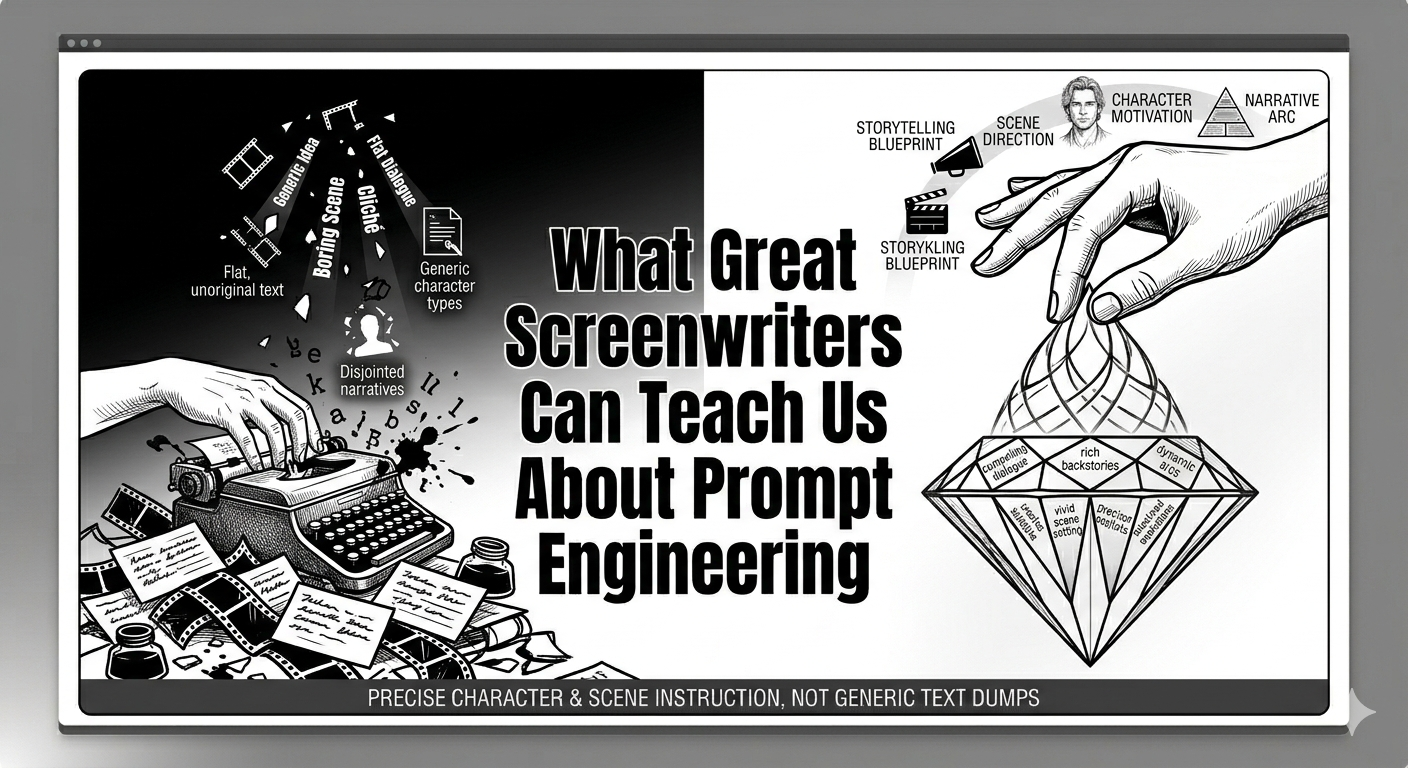
The people who’ve spent decades making strangers care about fictional characters have a lot to say about how to talk to AI
On the surface, a Hollywood screenwriter and a small business owner using AI tools don’t seem to have much in common. One is crafting dialogue for a crime drama. The other is trying to get a decent follow-up email out of ChatGPT before their next meeting.
But spend some time studying how great screenwriters think about their craft, and you’ll start to notice something: the principles they use to communicate clearly, create emotion, and guide an audience toward a specific feeling are almost identical to what separates a great AI prompt from a useless one.
Both disciplines are fundamentally about one thing — giving direction with enough precision that someone else can execute your vision without you standing over their shoulder explaining every decision.
Screenwriters have been doing this for over a century. We’d be smart to pay attention.
The First Lesson: Context Is Everything, Setup Is Not Optional
Veteran screenwriters know that a scene without proper setup is a scene that doesn’t land. You can write the most emotionally devastating moment imaginable, but if the audience doesn’t know who the character is, what they want, and what’s at stake, they won’t feel a thing.
This is why the first act of any well-structured screenplay does one job above all others: it establishes context. Before anything happens, we need to know who we’re following, what world they live in, and what they care about.
AI prompting works exactly the same way.
When you skip the setup and jump straight to the ask — “write me a marketing email” — you’re handing the AI a blank stage and hoping it improvises something that fits your production. Sometimes it gets lucky. Most of the time, it doesn’t. Because it has no idea who your character is (your customer), what world they live in (your industry), or what they care about (the problem they’re trying to solve).
Before you ask for output, set the stage. Who is the audience? What situation are they in? What do they already know, and what do they not know yet? What’s at stake for them?
A well-set-up prompt reads like a good first act. The AI knows where it is before it starts moving.
The Second Lesson: Write to an Audience of One
Here’s something that separates working screenwriters from beginners — the pros write every scene for a specific, imagined reader. Not “the audience” in the abstract. One person. A studio executive who reads five scripts a day. A producer who’s skeptical. They think about what that specific reader knows, what they’re tired of seeing, what would surprise them, what would make them keep reading.
This discipline forces clarity. When you’re writing for everyone, you’re writing for no one. When you’re writing for someone specific, every choice becomes sharper.
The same principle applies directly to AI prompting.
The moment you start thinking of your prompt as a brief written for one specific person — your ideal customer, a specific prospect, a defined buyer persona — the quality of the output transforms. Compare these two:
Lazy: “Write a social media post about our new service.”
Specific: “Write a LinkedIn post for a 45-year-old operations director at a 75-person manufacturing company who is skeptical of software vendors because of two bad implementation experiences. She’s not looking for hype — she wants evidence of reliability and a practical reason to consider something new.”
The second prompt isn’t harder to write. It just requires you to actually know who you’re talking to. And if you don’t know that yet — that’s the more important problem to solve first.
The Third Lesson: Subtext Over Text
One of the most-cited rules in screenwriting is “show, don’t tell.” It’s almost a cliché at this point, but the underlying principle is profound: audiences trust what they observe far more than what they’re told.
A character who says “I’m a good person” is less believable than one who quietly pays for the stranger’s groceries at checkout. You don’t explain what someone is — you demonstrate it through action and behavior, and you let the audience draw their own conclusions.
In prompt engineering, this translates into the habit of giving examples instead of descriptions.
If you want AI output to match your brand voice, don’t just say “write in a warm, professional tone.” Paste in two paragraphs from your best-performing email and say “write in this tone.” That’s subtext over text. You’re not telling the AI what good looks like — you’re showing it.
This is one of the fastest ways to level up your prompting immediately. Instead of describing the output you want, show the model an example of it. The output quality jump is immediate and significant.
The Fourth Lesson: Conflict Creates Clarity
Every screenwriting teacher will tell you the same thing eventually: a story without conflict is not a story. Conflict isn’t just the villain or the argument — it’s the tension between what a character wants and what’s standing in their way. That tension is what creates forward momentum. It’s what makes us lean in.
Great screenwriters don’t shy away from the obstacle. They build the whole story around it.
In prompting, the equivalent is being explicit about the tension your audience is experiencing — the friction, the hesitation, the objection. Most people write prompts that describe a rosy ideal. The better approach is to name the obstacle.
Instead of: “Write a landing page for our consulting services.”
Try: “Write a landing page for a business consulting firm targeting first-time entrepreneurs who are hesitant to hire a consultant because they think it’s expensive, they’re not sure what they’d actually get, and they’ve heard consultants overpromise and underdeliver. Address those three objections directly. Don’t oversell — build trust through specificity and honesty.”
You’ve now given the AI the conflict. And just like in a screenplay, the conflict creates the structure. The output will be infinitely more useful because it’s built around what’s actually going on in the reader’s head.
The Fifth Lesson: Respect the Reader’s Intelligence
There’s a temptation in both bad screenwriting and bad prompting to over-explain. To hammer the point. To make sure the audience couldn’t possibly miss it. But audiences — and customers — are sharp. When you explain too much, you lose them. You come across as condescending, or worse, desperate.
The greatest screenwriters trust their audience. They leave room. They let the viewer connect the dots. They know that the moment of connection — when someone understands something without being told — is the moment you’ve actually communicated something.
In prompting, over-explaining the output is a form of the same mistake. If you tell the AI to write an email and then add “make sure to sound professional” and “be clear about the offer” and “don’t be too long” and “make it friendly” — you’re padding instead of directing. You’re betraying your own uncertainty about what you want.
The sharper move is to be specific about the things that matter and silent about the things that don’t. If “professional” matters, give an example of what professional looks like in your industry. If length matters, give an exact word count or paragraph count. If friendliness matters, define what that means to you — because “friendly” means something different in a software startup than it does in a luxury real estate firm.
Trust yourself enough to be precise. The AI will follow.
The Sixth Lesson: Revision Is the Work
Here’s the thing most people don’t know about professional screenwriters: the first draft isn’t the goal. It’s the starting point. Scripts go through eight, ten, fifteen drafts before they’re ready. The writing process is, in large part, a rewriting process. The first draft gets something on the page. Every draft after that makes it better.
The people who get frustrated with AI and give up are usually treating the first output as the final output. It almost never is. That’s not a failure of the tool — it’s a misunderstanding of the process.
The correct mental model is iteration. You prompt, you review, you refine. Maybe the tone is close but not quite right — tell it that. Maybe the structure works but the opening is weak — fix just that. Maybe the whole thing needs to be shorter — say so. Each refinement pass is like a script note. You’re not starting over; you’re making it better.
This is where business owners and salespeople often leave serious quality on the table. They take the first output, sigh, and either use it reluctantly or abandon the effort entirely. The writers who get consistently great output from AI treat it as a collaborative draft process. First pass is a direction. Feedback is a revision note. The third or fourth exchange is usually where the good stuff lives.
The Seventh Lesson: Constraints Spark Creativity
Seasoned screenwriters will tell you that constraints are a gift. A scene that has to take place in one room with two characters and no music forces creative problem-solving that an open-ended brief never would. The limitation removes the noise and sharpens the focus. Some of cinema’s most memorable scenes were born from a budget restriction or a scheduling problem that forced the writer to find a smarter solution.
In prompting, constraints work exactly the same way — and most people drastically underuse them.
Telling the AI what NOT to do is often more powerful than telling it what to do. “Don’t use bullet points.” “Avoid superlatives — no ‘best,’ ‘greatest,’ or ‘leading.’” “Don’t mention price in the opening.” “No rhetorical questions.” “Avoid passive voice.”
Each constraint eliminates a class of bad outputs. The model can’t fall back on its most generic instincts because you’ve blocked the obvious exits. What’s left is usually far more original, far more specific, and far more useful.
Think of constraints not as limitations but as creative direction. You’re not restricting the AI — you’re pointing it toward the only place the good work can come from.
Putting It Together: A Prompt That Thinks Like a Screenplay
Let’s say you’re writing a sales email to a prospective client. Here’s how you’d apply everything above:
Set the stage (context): You’re a sales consultant at a boutique HR technology firm. Your prospect runs HR for a 120-person logistics company that just announced plans to expand to three new cities this year.
Write to an audience of one: She’s an experienced HR director who’s been burned by software that promised a lot and took nine months to implement. She values practical over flashy.
Name the conflict: Her core tension is growth pressure versus implementation risk. She needs something that scales but can’t afford another painful onboarding.
Show, don’t tell: Include a brief, specific reference to how your onboarding actually works — not adjectives about it, but a concrete detail or result.
Respect her intelligence: Don’t over-explain the offer. Make one clear ask. Trust her to follow up if she’s interested.
Constraints: Under 200 words. No “I hope this email finds you well.” No vague promises. Lead with her situation, not yours.
That’s not just a better prompt. That’s a brief a screenwriter would recognize. It tells the story before it’s written — and the output will reflect it.
The Bigger Picture
The most valuable insight screenwriting offers us isn’t a technique. It’s a mindset shift.
Great writers don’t sit down and just start typing, hoping something good emerges. They think first. They understand their audience. They know what the scene needs to do, who the characters are, what’s in the way, and what would make the moment land. The actual writing is the last step, not the first.
Most people approach AI prompting the opposite way. They type first and think later. They start with the output and figure out the context as they go.
Flip that order. Before you write a single word of your prompt, ask yourself: Who is this for? What do they need to feel or understand? What’s standing in their way? What does success look like?
Once you have clear answers to those questions, the prompt almost writes itself. And so does the output.
The screenwriters have known this for a long time. The best ones don’t write scenes — they engineer emotional outcomes. That’s exactly what you’re trying to do every time you sit down to craft a prompt.
You’re not generating text. You’re guiding a result.
Great writing — whether it ends up on a screen or in someone’s inbox — starts with the same discipline: knowing exactly what you want the other person to feel when it’s over.
Leave a Reply